How Spending 20 Minutes Outside Without a Destination Reshapes Afternoon Anxiety and Creative Thinking
Robert Kim
07/24/2026
6 min read
There is a particular quality to the mid-afternoon slump that most people know without being able to name it — that thickening of the mind around 2 or 3 p.m., when focus dissolves and the body begins to feel heavier than the morning left it. Emails pile up. Ideas go flat. A kind of low-grade tension accumulates in the shoulders and behind the eyes, not quite stress but not quite calm either. The instinct is usually to push through, to scroll, to refuel with another cup of coffee. Rarely does the instinct say: go outside, go nowhere, and don't bring a purpose with you.
The Mind Without an Agenda
There is a concept in Japanese practice called aimless wandering — or, in its more deliberate form, something close to what urban theorists have called the dérive (day-REEV), a French term meaning drift or flow, originally used to describe unplanned movement through a city in order to experience it without the filter of habit or destination. The idea is not about exercise. It is not about steps logged on a Garmin or a Fitbit. It is about allowing the senses to lead without the rational mind setting the itinerary. When the brain is released from the obligation to arrive somewhere, something interesting happens: it begins to make connections it was too busy to notice before.
This is not mysticism. The brain operates in two broad modes — one focused and deliberate, the other diffuse and associative. Most desk work lives entirely in the first mode, which is efficient but also exhausting, because it suppresses the quieter background processing where creative synthesis actually happens. A 20-minute walk with no route and no podcast playing gives the associative network room to surface. Problems that felt locked often look different after returning from even a short, directionless loop around the block.
What Afternoon Anxiety Actually Is
Afternoon anxiety is rarely about a specific threat. It tends to be the accumulated residue of a morning spent in reactive mode — responding, deciding, performing — without adequate space between demands. The nervous system doesn't distinguish between genuine urgency and the low-level urgency of a full inbox. By early afternoon, the stress response has been activated enough times that cortisol levels remain subtly elevated, producing that restless, unsettled feeling that often reads as either irritability or a vague dread about the rest of the day. The body is primed for action it isn't being asked to take.
Unstructured outdoor movement addresses this directly. Walking — especially slow, non-goal-oriented walking — activates the parasympathetic nervous system, the branch responsible for rest and recovery. Exposure to natural light, even filtered through an overcast sky, shifts the body's internal chemistry in ways that indoor light cannot replicate. The temperature and air quality outside, even in urban environments, differ enough from interior spaces to register as a mild environmental shift. In neighborhoods like Brooklyn's Prospect Park area or along Chicago's Lakefront Trail, people often describe a visible softening in the body after a few minutes outside that they don't achieve by sitting quietly indoors.
The Creative Dividend of Getting Lost
Some of the most productive creative cultures in history — from the Romantic-era poets walking the English Lake District to the Bauhaus students encouraged to observe before designing — understood that unstructured movement and observation were not breaks from the work. They were the work. The contemporary version of this principle shows up in practices embraced by designers, writers, and architects who use what they sometimes call a thinking walk: a deliberate but directionless outdoor period specifically intended to let a problem metabolize without direct attention.
The mechanism involves what psychologists call incubation — the process by which the brain continues working on a problem beneath conscious awareness. Incubation is most effective when the conscious mind is mildly engaged elsewhere, which is exactly what an aimless walk provides. The senses are occupied enough to prevent rumination, but not so occupied that deep processing is crowded out. The result is that insight — the sudden clarity about a project, a conversation, a financial decision — tends to arrive during or just after the walk rather than while staring at a screen. Apps like Notewise or a simple voice memo tool on a phone can capture those moments without disrupting the walk itself.
Why the Absence of Destination Matters
The destination-free aspect of this practice is not incidental. When a walk has a purpose — running an errand on the way to Trader Joe's, walking to a meeting, completing a specific loop — the planning mind remains engaged. The route is calculated. Time is monitored. The brain is still, in a meaningful sense, at work. The shift that produces the anxiety-reducing and creativity-enhancing effects requires a genuine release of agenda, which is harder to manufacture than it sounds. Most people find the first three to five minutes of an aimless walk mildly uncomfortable, because the mind immediately searches for a goal to attach to the movement. That discomfort is worth sitting with. It tends to pass, and what comes after it is the condition that actually matters.
For those who find complete aimlessness difficult, a useful bridge is to set a loose sensory intention rather than a destination — noticing every shade of green on the walk, or listening specifically to sounds above a certain height. This keeps the mind present and grounded without reintroducing the planning mode that undermines the practice. The point is to be genuinely outside of the task-completion framework, even for a short period.
Building the Habit Into the Afternoon
Twenty minutes is the threshold at which most of the measurable shifts — in mood, in mental clarity, in the subjective sense of calm — appear to consolidate. Less than that can still help, but the window between roughly fifteen and twenty-five minutes seems to be where the benefit becomes consistent rather than occasional. The timing within the afternoon also matters: the window between 1:30 and 3:30 p.m. tends to align with both the natural circadian dip in alertness and the peak accumulation of morning stress, making it the most efficient moment to interrupt the cycle.
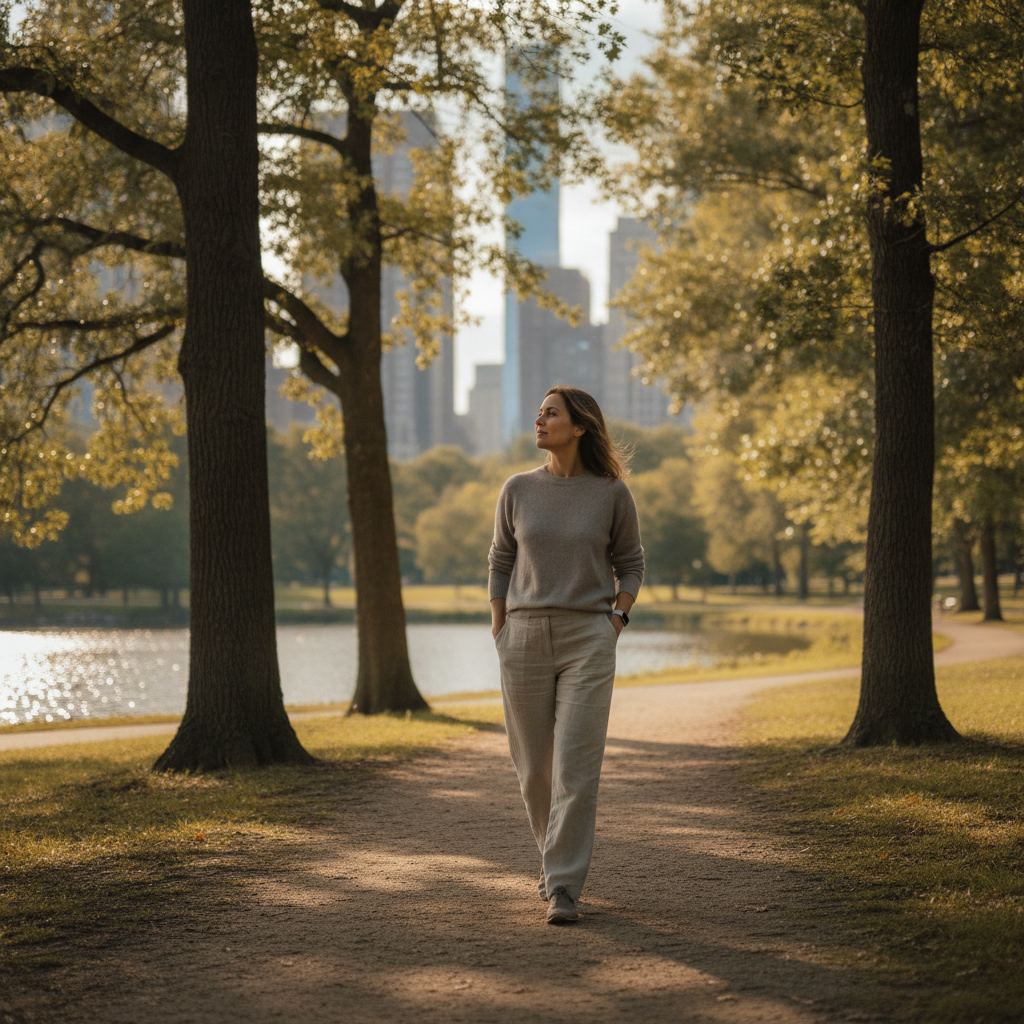
The practice doesn't require a park or a natural setting, though those environments do add additional benefit through what researchers loosely call soft fascination — the gentle, involuntary attention drawn by moving leaves, water, or open sky. Urban sidewalks work. A loading dock. A quiet commercial street in the middle of the afternoon. The outdoor environment itself is the primary variable, not its beauty. Even stepping outside a building in a dense city block and walking without a map for 20 minutes produces the shift that sitting at a desk — even near an open window — does not.
When you step back inside after one of these walks, the afternoon tends to open rather than close. The anxiety that had been quietly accumulating has somewhere to go. The project you couldn't see clearly from your chair looks different now — not because you thought harder about it, but because you briefly stopped. The act of going nowhere, it turns out, is one of the more useful places the afternoon can take you.