How Reading Appliance Model Number Suffixes at Big Box Retailers Reveals Whether You Are Buying This Year's Build or Last Year's Inventory
Chris Martinez
08/15/2026
5 min read
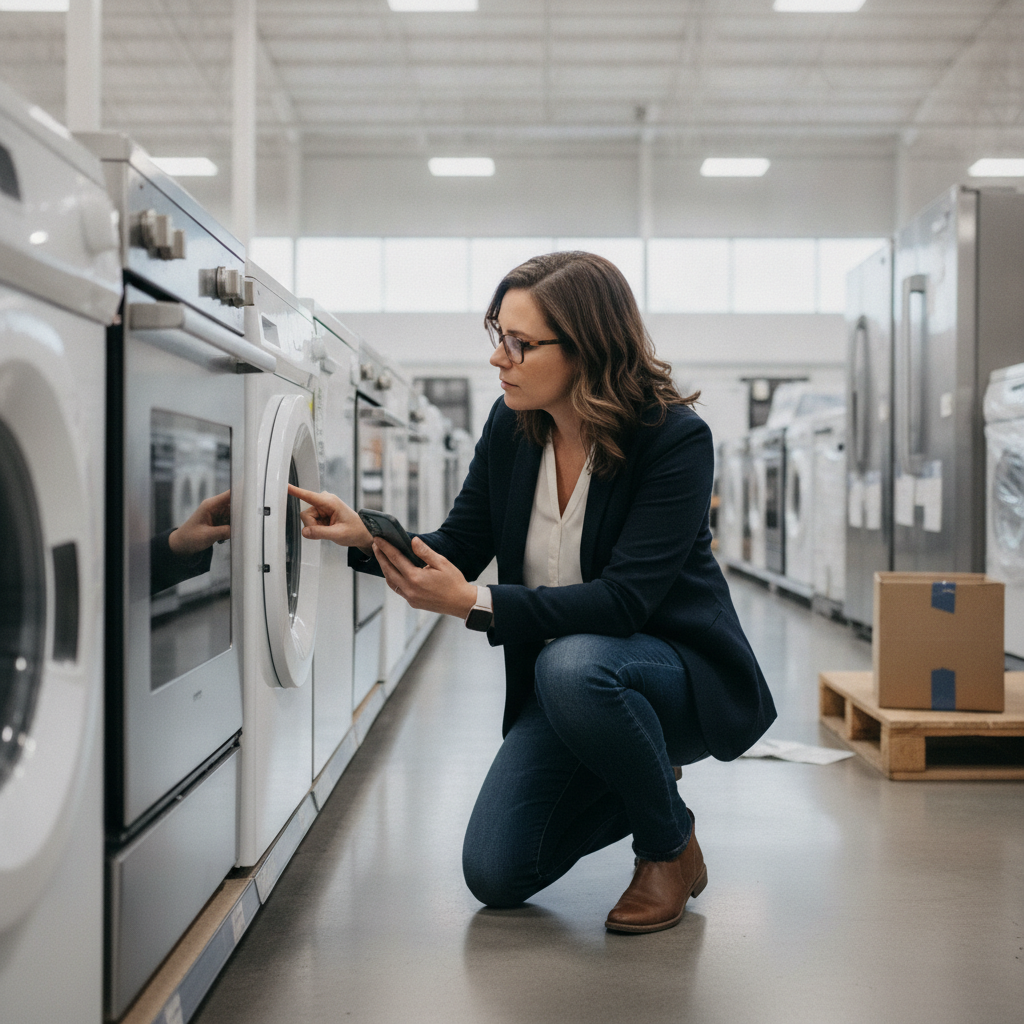
Appliance model numbers are not random strings of letters and digits — they are structured codes that carry specific information about product generations, manufacturing years, and regional distribution runs. Most shoppers treat these numbers as interchangeable identifiers, but retailers like Best Buy, Home Depot, and Lowe's routinely stock both current-year models and prior-year units on the same floor, often at similar prices. Learning to read the suffix portion of a model number takes less than five minutes and can mean the difference between buying a current build or inheriting obsolete technology at a premium price.
What Do Appliance Model Number Suffixes Actually Encode?
Manufacturers build model numbers in segments, each carrying distinct meaning. The prefix typically identifies the product category and brand line, the middle section describes configuration details like capacity or finish, and the suffix — usually the final one to three characters — encodes the production year or regional variant. Samsung, for instance, uses a letter-based year code in a predictable rotation. Whirlpool and Maytag embed a two-digit year code later in the string. LG similarly uses a positional letter to denote the model year within its numbering convention. These codes are not hidden, but they are rarely explained on sales floors.
How Manufacturers Assign Year Codes Across Major Brands
Each major appliance manufacturer uses its own system, though the underlying logic is consistent. Samsung refrigerators and washers released in a given year share a common letter at a specific position in the model number, and that letter advances alphabetically each year. Whirlpool-owned brands, which include Maytag, KitchenAid, and Amana, embed a two-character year-and-manufacturing-sequence code that experienced buyers learn to cross-reference using publicly available production charts. LG places its year code as the second character in most appliance model numbers. Once a buyer knows which position to look at for each brand, identifying a unit's model year becomes a matter of seconds.
Why Big Box Retailers Mix Current and Prior-Year Models on the Floor
Retailers have legitimate inventory management reasons for keeping older models on the sales floor alongside newer builds. Manufacturers release updated versions on rolling schedules — rarely all at once — so older stock naturally occupies display space until it clears. Floor models, open-box units, and closeout inventory further complicate the picture. A refrigerator sitting on the showroom floor at Home Depot might be a current-year build or a unit manufactured eighteen months ago that simply hasn't sold. Both will often carry nearly identical price tags unless the prior-year model has been explicitly marked down. Without reading the suffix, a buyer has no way to distinguish them.
What Differences Actually Exist Between Model Year Builds?
The practical gap between a current-year appliance and its predecessor varies by category. In refrigerators and dishwashers, year-over-year updates frequently include improved compressor efficiency ratings, updated control board firmware, and refined water filtration systems. In washing machines, newer builds may carry updated drum geometries or revised motor configurations that affect noise levels and energy draw. For buyers who prioritize long-term ownership costs, a current-year model often delivers measurable improvements in energy efficiency that compound over a decade of use. In contrast, for a buyer purchasing a basic dryer or a second-unit freezer, the year-over-year distinction may matter far less, and a prior-year unit at a reduced price could represent genuine value.
How to Look Up Year Codes Before You Walk Into a Store
Here is where practical preparation makes a real difference. Before visiting a retailer, you can look up the specific year-code conventions for whichever brand you plan to evaluate. Samsung publishes appliance year code guides through its support documentation, and third-party appliance research sites compile decoding tables for Whirlpool, LG, GE, and Bosch lines. Once you know the system, write the current-year code character on your phone's notes app and bring it with you. When you find a model on the floor, locate the suffix, compare it against your reference, and you'll know within seconds whether that unit reflects the current production cycle. If the suffix indicates a prior year and the price hasn't been reduced accordingly, you have a concrete basis for requesting a discount at the service desk.
What Should You Do With This Information at the Register?
Once you've identified a prior-year model at a current-year price, the next step is straightforward: use it as a negotiating point. Ask a sales associate or department manager to confirm the model year and request a markdown to reflect that status. At retailers like Best Buy and Lowe's, floor-level managers have discretion to apply reductions on aging inventory, particularly if a newer model version is visible elsewhere on the floor. If the store won't negotiate, check whether the prior-year unit is available at a further discount through the retailer's open-box or clearance section. You can also use the model year information to compare true ownership costs — a slightly older unit at a ten to fifteen percent discount may still carry strong reliability ratings, making it a defensible choice if the efficiency gap between generations is modest.
Appliance model numbers reward the shoppers who take time to understand them. The suffix is not a minor administrative detail — it's the clearest signal a floor unit can give about where it sits in a product's lifecycle. Retailers benefit when buyers ignore this information, because undifferentiated pricing on mixed inventory quietly pushes older stock at current-year margins. Reading those final characters before committing to a purchase shifts that information advantage back to the buyer, making it one of the simplest and most reliable tools available for spending less without accepting less.