Georgia's Svaneti Region in Early June Offers Snow-Capped Towers and Empty Trails Before Summer Trekkers Arrive
Marcus Chen
08/02/2026
6 min read
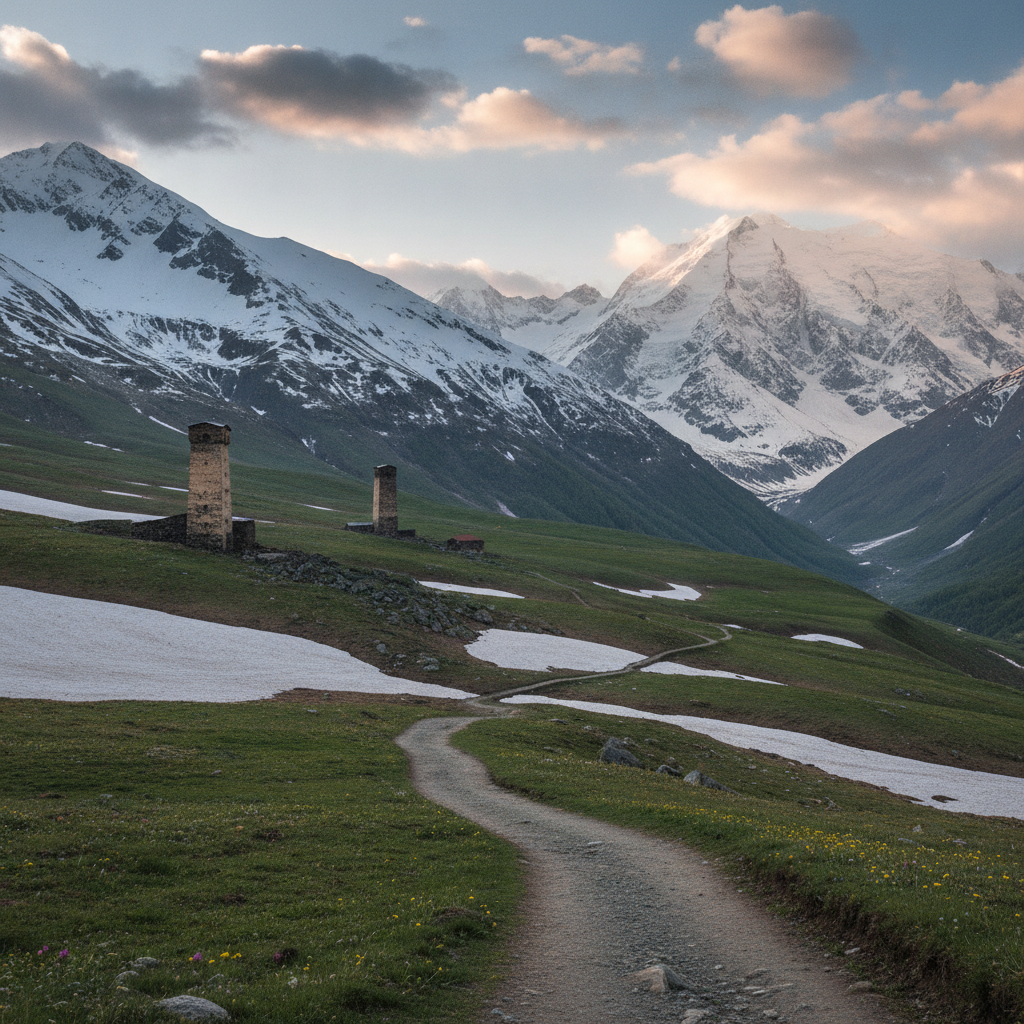
There is a particular kind of silence that belongs only to high mountain villages — the kind where wind moves through stone towers that have stood for a thousand years and no tour bus has yet disturbed the morning. In Georgia's Svaneti region, that silence lingers well into early June, when the alpine meadows are just beginning to green and the Caucasus peaks above Mestia still wear their winter crowns of snow. Most travelers who know Svaneti at all know it from the summer rush — the dusty trails of July, the packed guesthouses, the Instagram queue forming at every iconic viewpoint. Arriving six or eight weeks earlier means stepping into a different place entirely: quieter, colder at night, and almost impossibly beautiful in that unpolished way that heavily trafficked destinations rarely offer anymore.
Svaneti sits in northwestern Georgia, wedged between the Greater Caucasus mountains and accessible by a combination of flight or overnight train to Kutaisi, followed by a shared marshrutka minibus or rented car north through increasingly dramatic gorges. The journey itself signals something — the road climbs, the cellular signal fades, and by the time the medieval defensive towers of Mestia come into view, the traveler understands they have arrived somewhere genuinely remote. These towers, some dating to the ninth and tenth centuries, were built by Svan families as retreats during blood feuds and foreign invasions. Dozens still stand in and around Mestia, and several more cluster in the villages of the Ushguli community further east, which at roughly 2,200 meters elevation is among the highest permanently inhabited settlements in all of Europe.
The Case for Coming Before the Crowds
The argument for early June in Svaneti is not merely about solitude, though that alone would be reason enough. The light in late spring behaves differently than summer light — it arrives softer in the mornings, and the snow on peaks like Mount Shkhara, which rises to nearly 5,200 meters, catches the low sun in a way that seems almost theatrical. Wildflowers that would be trampled by August foot traffic are still intact and dense along lower trail segments, and the rivers running off the snowmelt are at their most dramatic, turbulent and glacially colored. Guesthouse hosts, who in peak season manage a constant rotation of guests, have more time to sit at dinner and explain the nuances of Svan culture, the meaning of the traditional salt mixture known as svanuri marili, and the unwritten rules of hospitality that have governed the region for centuries.
There are practical trade-offs worth understanding before booking. Some higher-elevation trails, particularly the routes toward the Guli Pass or the more ambitious approaches to the Chalaadi Glacier, may still have snow patches requiring basic traction devices or poles. The marshrutka schedule between Mestia and Ushguli runs less frequently in late May and early June, which means travelers without a rental car need to coordinate carefully or hire a local driver, typically arranged through guesthouse hosts for a modest daily fee. A handful of the smaller village guesthouses open only after mid-June, but Mestia itself has sufficient accommodation operating year-round, and the quality of a home-cooked meal of kubdari — the meat-stuffed bread that Svans consider their own, distinct from the Adjaran or Mingrelian versions — does not diminish in the off-season.
Planning the Logistics Without Overpaying
Getting to Svaneti affordably requires a bit of routing creativity. Most international arrivals land at Tbilisi International Airport, and from there the options diverge. The overnight train from Tbilisi to Zugdidi, which connects to Mestia by shared minibus, costs a fraction of a domestic flight and drops travelers in the region feeling appropriately unhurried. For those who prefer air, Vanilla Sky Airlines operates seasonal flights directly to Mestia Airport from Tbilisi, though the schedule is weather-dependent and the short runway has a habit of generating last-minute cancellations — building in flexibility is non-negotiable.
For planning purposes, the app Tripadvisor remains useful for reading guesthouse reviews and filtering those with English-speaking hosts, which matters in a region where Georgian and the distinct Svan language dominate. Google Maps works adequately in Mestia proper but becomes unreliable on mountain trails, making the maps.me app — which allows full offline download of the Svaneti region — the more reliable companion once boots hit the trail. Travelers managing trip costs in real time often find Wise useful for converting currency without punishing exchange rates, since Georgia uses the lari and ATM availability outside Mestia is essentially nonexistent.
Budgeting for Svaneti in early June tends to reward rather than punish travelers who plan ahead. Guesthouse rates in this shoulder period run noticeably lower than peak July pricing, and full board — breakfast and dinner included — is standard practice among family-run operations. The relative affordability of Georgia as a destination amplifies this further: a well-fed, comfortable day in Mestia costs a fraction of what an equivalent alpine experience would run in Austria or Switzerland. The financial case for traveling thoughtfully and seasonally is rarely more obvious than it is here.
What the Days Actually Look Like
A well-paced four to five-day itinerary allows for genuine exploration without the exhaustion of over-scheduling. The first day or two spent in and around Mestia — walking between the towers, visiting the Svaneti Museum of History and Ethnography where ancient icons and gold artifacts hint at the region's medieval importance, and taking the afternoon cable car to the Hatsvali ski area for panoramic views of the surrounding peaks — establishes the scale and character of the landscape before venturing further. The day trip east to Ushguli, roughly 45 kilometers along a famously rough road, is the journey most travelers center their Svaneti experience around, and rightly so: arriving in a cluster of tower houses with Shkhara looming directly behind them, with almost no one else present in early June, is the kind of moment that quietly recalibrates a traveler's sense of what remote actually means.
For those with trekking experience, the route from Mestia to Zhabeshi along the lower slopes of the range takes two days at a relaxed pace and passes through villages where goats outnumber people and the towers appear around bends with no warning. The Chalaadi Glacier walk, beginning just outside Mestia, is achievable in half a day and gets dramatically close to a wall of ancient ice that has been receding visibly in recent decades — a sobering counterpoint to the timeless quality everything else in Svaneti projects. Returning to the guesthouse in the late afternoon, with the smell of woodsmoke drifting from neighboring houses and the mountains catching the last light, is the kind of ending to a day that is very hard to manufacture anywhere else.
Svaneti in early June asks something of the traveler — some tolerance for unpredictability, some willingness to slow down and accept that the best moments here arrive unscheduled. In return, it offers the rare experience of a genuinely extraordinary place before the world fully arrives. Starting the planning process now, before the summer window fills in, is the simplest way to make sure that window doesn't close before it's used.