Morocco's Draa Valley in March Offers Blooming Desert Palms and Empty Kasbah Guesthouses Before Spring Tourists Arrive
Jennifer Walsh
08/09/2026
5 min read
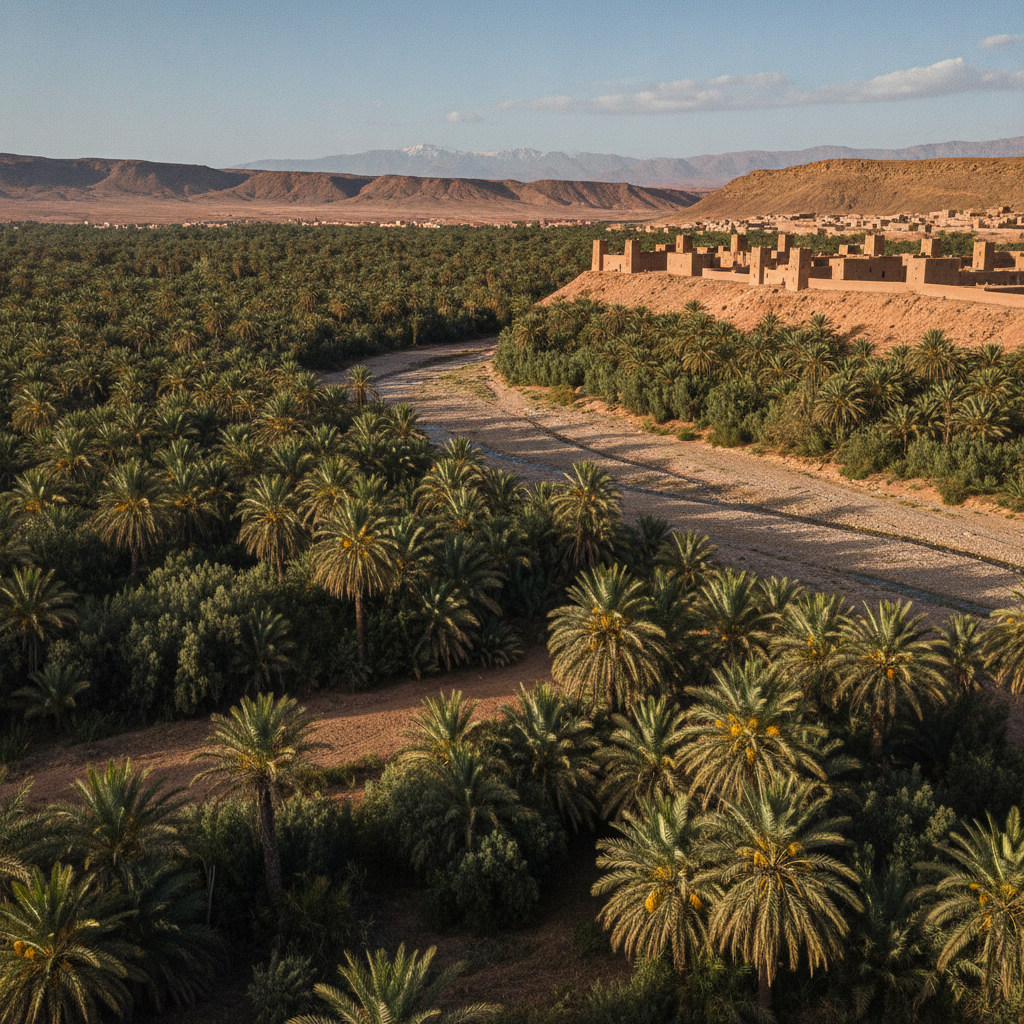
There is a particular kind of quiet that settles over a desert valley just before the world discovers it. In Morocco's Draa Valley, that quiet arrives in March — when the date palms are feathering out with new growth, the almond trees have already dropped their blossoms across the red earth, and the kasbah guesthouses still have rooms available without a weeks-long advance reservation. It is a window that experienced travelers know about and rarely discuss, precisely because its value depends on the crowds staying away a little longer.
The Valley Before the Rush
The Draa Valley stretches roughly 200 kilometers south of Ouarzazate toward the Saharan fringe near Zagora, threading through a corridor of oasis greenery that feels improbable against the surrounding hammada — the rocky, wind-scoured plateau that dominates much of southern Morocco. In March, daytime temperatures sit comfortably in the low-to-mid twenties Celsius, warm enough for full days of exploration without the punishing heat that arrives by May and stays through September. The light at this time of year has a particular clarity, arriving at lower angles that cast long shadows across the ksar walls and illuminate the geometric earthen architecture in ways that midday summer sun simply flattens out. Spring wildflowers push up through the gravel margins of the palmery paths, and the irrigation channels — the khettaras — run fuller than they will later in the season, carrying snowmelt down from the High Atlas through a network of underground passages that have sustained this landscape for centuries.
The practical consequence of visiting now rather than in April or October — the traditional shoulder-season peaks — is immediate and measurable. Accommodation prices across the valley drop noticeably in early March, and availability at the best-known maison d'hôte properties in villages like Agdez and Tamegroute is genuinely open rather than competitive. The riad-style guesthouses nested inside the old ksour, those fortified mud-brick villages that stack up against the valley walls, accept same-week bookings rather than requiring the lead times that accumulate once travel media begins its annual spring-destination cycle. Booking.com shows real-time availability clearly for most of these smaller properties, and filtering by guesthouse or riad category rather than hotel tends to surface the family-run places that offer proper Moroccan breakfasts and local knowledge the chain-adjacent options cannot match.
Moving Through the Valley Strategically
Most visitors to the Draa approach it as a single-day detour from Marrakech or a transit route to the Erg Chebbi dunes near Merzouga, which means they see the valley from a moving vehicle and miss the texture entirely. The better approach, especially in March when the pace is unhurried, is to base yourself in the valley for at least three nights and move through it slowly by local taxi, rented bicycle, or on foot along the palmery irrigation paths. The village of Nkob, sitting on the eastern edge of the valley near the Jebel Saghro foothills, offers a cluster of small auberges with rooftop terraces that face the mountains rather than the road — a distinction worth seeking out when the Atlas foothills glow amber at dusk. Zagora, the larger town at the valley's southern end, functions as a useful resupply point and transport hub but holds less atmospheric appeal than the smaller ksar communities strung along the route.
For navigation and offline mapping in areas where connectivity becomes inconsistent, Maps.me or the offline download function within Google Maps handles the Draa Valley road network reliably — particularly useful if you're renting a car in Ouarzazate and driving the main N9 highway south while planning detours into the palmery tracks that branch toward the river. The road surface is well-maintained along the primary corridor, though the tributary tracks that lead into the older village quarters often narrow to single-lane packed earth that rewards patience over speed.
The kasbah architecture of the Draa is among the most concentrated anywhere in Morocco, and March gives you access to it without the guided group queues that form at the more famous Aït Benhaddou, roughly 30 kilometers northwest of Ouarzazate. Smaller ksour along the Draa — Tamnougalt in particular, one of the oldest and best-preserved in the valley — can be explored with a local guardian for a modest contribution, and the absence of crowds allows a kind of unhurried attention to the carved stucco details and cedar ceiling work that gets impossible when groups cycle through on 30-minute windows.
Practical Logistics and Budget Reality
Flying into Marrakech Menara Airport and renting a vehicle for the drive south over the Tizi n'Tichka pass remains the most flexible approach, though the route demands full attention — the pass climbs above 2,200 meters and the road is genuinely serpentine rather than dramatically difficult. Alternatively, CTM, Morocco's national intercity bus operator, runs reliable daily connections from Marrakech to Ouarzazate and onward to Zagora, making the Draa accessible without a car for travelers willing to work around a fixed schedule. Shared grands taxis fill the route between valley towns efficiently and cheaply, departing when full from the main taxi stands rather than on a printed timetable.
Accommodation costs in March typically run well below what the same properties charge in October, and meals at village restaurants — tagines, harira, msemen flatbreads with argan oil — reflect local rather than tourist pricing when you eat where residents eat rather than where menus appear in multiple languages. Currency exchange is straightforward at Marrakech's medina or Ouarzazate's bank branches; XE Currency provides real-time dirham rates for quick reference before any larger transaction. The broader point is that a week in the Draa Valley in March, done thoughtfully, costs substantially less than the same itinerary repeated two months later — not because the valley is undiscovered, but because the demand curve hasn't peaked yet.
The Draa rewards a particular kind of traveler: one who finds the texture of a place more interesting than its headline attractions, and who understands that the best version of most destinations arrives just before the season officially opens. The palmery paths in March belong almost entirely to the people who live along them — farmers clearing the irrigation channels, women carrying loads from the weekly souk, children walking the narrow lanes between mud walls that have stood since the sixteenth century. That version of the valley is available right now, and it won't stay that way much longer.