Oaxaca's Día de los Muertos Celebrations Beyond the Main Plaza Reveal Village Traditions Tourists Rarely Witness
Jennifer Walsh
07/25/2026
6 min read
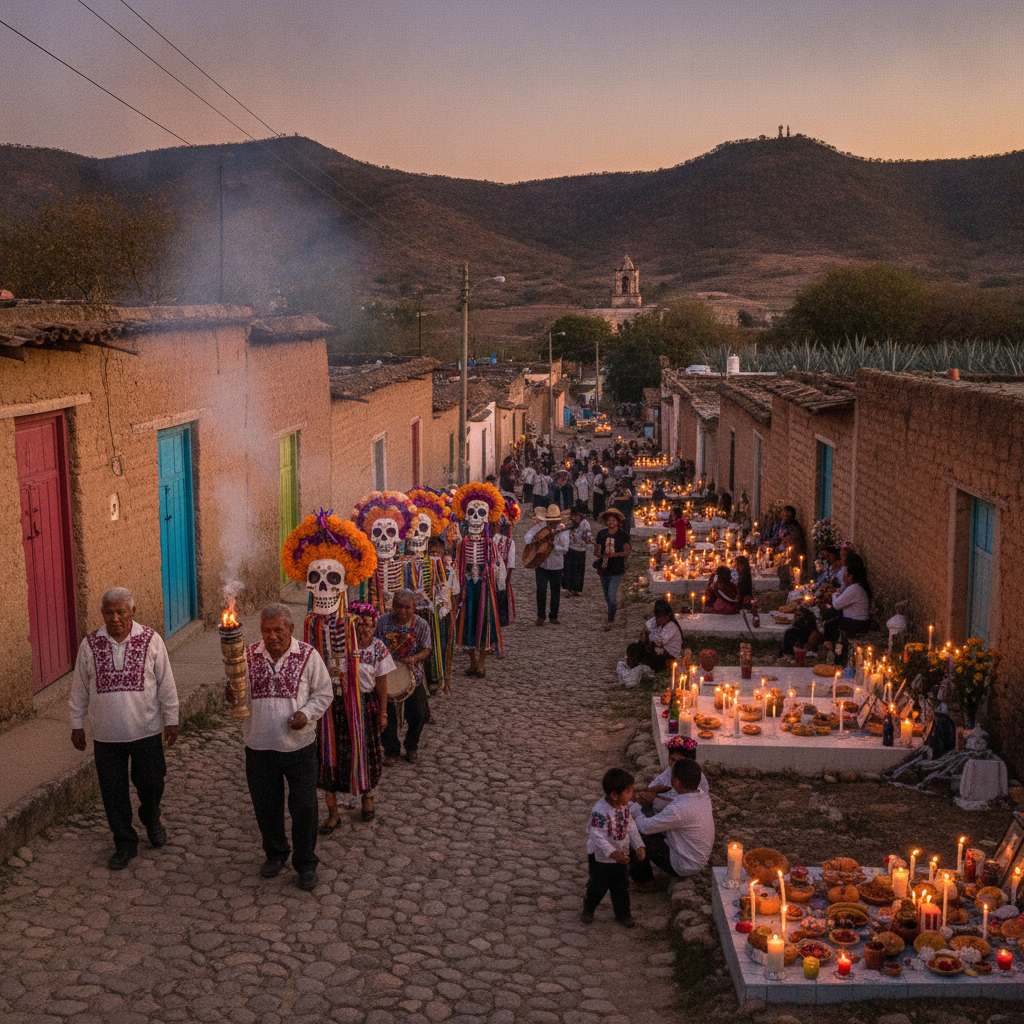
Every year, the same photographs travel around the world — marigold-covered altars, candlelit cemeteries, elaborately painted faces pressed together in the glow of a November night. These images are real, and they are beautiful, but they belong to a version of Oaxaca that has been, in part, shaped by the very attention it receives. The deeper ceremony, the one rooted in something older and quieter, unfolds in the villages that ring the Central Valleys — places where the dead are received not as spectacle but as guests, and where the living prepare for weeks before a single candle is lit.
What Día de los Muertos Actually Celebrates
Día de los Muertos — literally, Day of the Dead — spans November 1st and 2nd and draws on a convergence of pre-Hispanic indigenous rituals and Catholic traditions that arrived with Spanish colonization in the 16th century. The holiday is rooted in the Zapotec and Mixtec belief that the boundary between the living and the dead dissolves during this period, allowing souls to return and share a meal with their families. The ofrenda (altar) is not decoration but an invitation — a carefully arranged threshold of marigolds, copal incense, food, photographs, and objects the deceased loved in life. In Oaxaca, where indigenous identity remains particularly strong, this is observed with a depth that varies enormously depending on whether one is standing in the state capital or a small village three hours into the mountains.
The Capital's Celebration and Its Crowds
Oaxaca City itself becomes genuinely extraordinary during the holiday. The cemetery of San Miguel Chapultepec fills with candlelight, and the zócalo — the main plaza — hosts folk dancers, mezcal vendors, and musicians performing sones from the Sierra. The Mercado de Abastos overflows with cempasúchil (marigold) vendors, and the streets smell of copal before dawn. But the city has also become a destination in its own right, drawing thousands of visitors whose presence has changed the texture of the celebration in subtle ways. It remains meaningful, but it is also managed — guided, photographed, and packaged in a way that the village ceremonies are not. Those who arrive expecting quietude in the city cemetery will find instead a kind of beautiful, crowded theater.
Village Ceremonies That Run on Their Own Time
The communities surrounding Oaxaca City — places like Teotitlán del Valle, San Antonino Castillo Velasco, and Atzompa — each observe the holiday according to their own inherited customs, and those customs do not always align with the official two-day calendar. In some villages, the preparations begin days earlier with the construction of arcos — elaborate floral archways built at home altars and at grave sites. In others, families gather at the cemetery on the night of October 31st to clean and decorate the graves, a ritual called velación (vigil), and remain through the night in a combination of prayer, storytelling, and shared food. These communities are accessible by local bus or a short drive from the city, but they are not designed for visitors, which is precisely what makes them worth seeking out.
The Language of Altars and What They Communicate
An ofrenda is a composition, and learning to read one reveals the texture of a family's grief and memory. A shot glass of mezcal beside a photograph indicates who the person was. A child's altar — distinguished by candy, toys, and a small white cloth — belongs to the angelitos, the little souls who died young and are said to arrive on November 1st, a day before adult souls. Copal, the resinous incense burned throughout Oaxacan celebrations, is believed to guide the dead home by scent — its smoke functioning as a literal road between worlds. In village homes, these altars are layered, multigenerational affairs, sometimes spanning multiple tables and featuring photographs going back decades. To be invited to view a family's ofrenda is an act of trust, and the appropriate response is quiet attentiveness rather than photography.
Teotitlán del Valle and the Weaving of Ceremony Into Daily Life
Teotitlán del Valle, roughly 30 kilometers from Oaxaca City, is best known for its Zapotec textile tradition — the hand-woven wool rugs sold throughout the region. But during Día de los Muertos, the village reveals another dimension entirely. Families here construct altars of unusual size and elaboration, often incorporating the geometric patterns of their weaving tradition into the floral arrangements. The community cemetery becomes a site of sustained collective gathering — not a performance for outsiders but a genuine reunion, where neighbors move between grave sites sharing food and memories. The village's proximity to the city makes it reachable without a car, but arriving after dark on November 1st, when the cemetery vigil is already underway, is far more meaningful than a midday visit.
How to Engage Respectfully With Village Celebrations
The difference between witnessing and intruding is a matter of posture, pace, and intention. Villages like Atzompa and San Antonino Castillo Velasco do not have formal visitor programs, and that absence is deliberate. The following approaches allow travelers to be present without being disruptive.
- Hire a local guide from Oaxaca City who has existing relationships with village families rather than booking a large tour group.
- Learn a few phrases in Spanish at minimum — mucho gusto (nice to meet you), con su permiso (with your permission), and lo siento (I'm sorry for your loss) go an enormous way.
- Ask before photographing anything, and accept a no with grace. Many families are happy to share their ofrenda in conversation; fewer want it published on the internet.
- Bring something to contribute if invited into a home — pan de muerto (bread of the dead), fruit, or flowers are all appropriate.
- Stay in Oaxaca City and take day or evening trips rather than attempting to sleep in a village that hasn't built its infrastructure around tourism.
The Return to the Source
There is something worth sitting with in the fact that the most photographed celebration in Mexico contains, at its heart, a set of rituals designed entirely for the dead. The marigold petals scattered from cemetery gate to grave site are not art installation — they are a path, laid out so a soul that has been absent all year can find its way home by following the scent of flowers in the dark. Standing in a village cemetery at midnight, surrounded by families who have been coming to this exact spot for generations, it becomes impossible to experience the holiday as a backdrop. The ceremony asks something of whoever witnesses it: a moment of genuine stillness, and perhaps a quiet thought about who, in one's own life, deserves to be remembered this thoroughly. That is the tradition the main plaza cannot fully hold, and the reason the villages remain worth the journey.