How Traveling Through Portugal's Alentejo Wine Region in Late Autumn Reveals a Side of Europe Most Visitors Never See
Robert Kim
07/09/2026
5 min read
Europe in November belongs to the locals. The coach tours have retreated, the summer-rental signs have been taken down, and the continent exhales into a quieter rhythm that most visitors never witness — one measured not by beach weather or festival dates, but by harvests, hearths, and the particular golden light that low winter sun throws across ancient stone. Portugal's Alentejo region, that vast, cork-studded plateau stretching south of Lisbon toward the Spanish border, offers one of the most rewarding versions of this seasonal surrender. It is a place that resists easy categorization at any time of year, but in late autumn it becomes something rarer still: a working landscape in transition, unhurried and entirely itself.
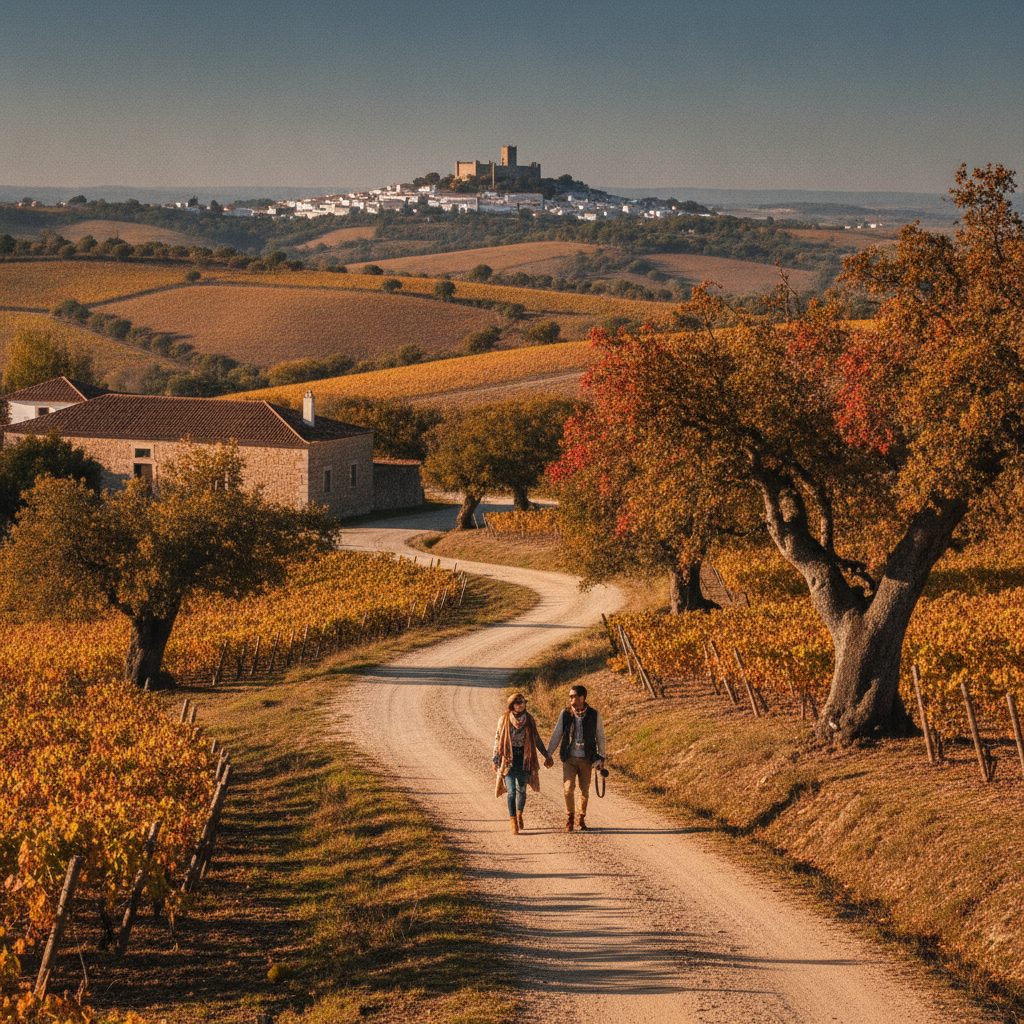
The Alentejo — the name derives from the Portuguese além do Tejo, meaning "beyond the Tagus" — covers roughly a third of Portugal's land area but holds only a fraction of its population. Its vastness is part of its character. Rolling plains of ochre and rust stretch toward horizons interrupted by lone cork oaks, montados (the traditional cork-oak woodland system that defines the regional ecology), and the occasional whitewashed village crowned with a castle or a church. In November, after the grape harvest is complete and before the winter rains turn the plains green, the landscape takes on a stripped-back quality — drystone walls, bare vine rows, smoke rising from farmhouse chimneys — that is bracingly honest about what the land actually is and what it actually does.
Wine, Ceremony, and the Weight of the Harvest
The Alentejo is one of Portugal's most significant wine-producing regions, responsible for a disproportionate share of the country's bottled exports despite its relatively modest size. Its warm continental climate — long, dry summers moderated by Atlantic influence — produces wines of unusual concentration and character, from the earthy, structured reds made with Alicante Bouschet and Aragonez grapes to aromatic whites built on Antão Vaz and Arinto. Visiting in late autumn places a traveler in the immediate aftermath of the vindima, the grape harvest, a period when the wineries are processing and resting, the vineyard workers have dispersed, and the wine itself is quietly becoming. Estates like Herdade do Esporão, one of the region's most recognized producers, operate extensive properties that visitors can tour even after the harvest rush subsides. Walking the quiet rows in November, with the vine leaves turned to amber and burgundy and the soil still holding the warmth of the picking season, delivers a more intimate understanding of viticulture than any summer tasting room visit can offer.
The Villages That Tourism Forgot to Rush
Évora, the regional capital and a UNESCO World Heritage city, earns its designation through sheer accumulated history — Roman temple columns rising from a medieval plaza, an ossuary chapel whose walls are lined with the bones of Franciscan monks, narrow streets of Moorish geometry overlaid with Manueline ornament. In summer, Évora manages its crowds with practiced efficiency. In late November, the city returns to the pace of a working Portuguese market town, its cafés full of pensioners playing cards, its covered market selling local cheeses, black pork sausages, and Alentejo olive oil to residents who have no interest in Instagram. Smaller villages — Monsaraz, perched on a hilltop above the Alqueva reservoir, and Estremoz, famous for its marble quarries and Saturday market — feel in this season less like curated experiences and more like places where actual lives are lived. The distinction matters more than it sounds.
The Black Pork and the Bread: Eating in the Alentejo
Alentejo cuisine is architecture disguised as food. The açorda, a bread-thickened soup enriched with garlic, olive oil, eggs, and fresh coriander, is built from the logic of frugality and transformed by quality ingredients into something deeply satisfying. The migas, another bread-based preparation often served alongside slices of porco preto — the acorn-fed black Iberian pig, whose production represents a cornerstone of the regional food economy — demonstrate the same principle. Nothing is wasted, and nothing is rushed. Regional restaurants in Évora and the smaller towns still practice a style of service that predates the hospitality industry's obsession with turnover: a meal here is an event with a beginning, middle, and unhurried end. The regional wine, poured generously and priced modestly by the carafe, completes a picture of eating as communal ritual that feels genuinely countercultural in a world increasingly organized around delivery apps and dietary optimization.
Moving Through the Landscape at November's Pace
The practical case for visiting Alentejo in late autumn is straightforward. Accommodation rates at quintas — the farmhouse estates that have increasingly opened their doors to guests — drop considerably from their summer peaks. The roads between villages, empty of tour buses, become something genuinely pleasurable to drive, particularly the secondary routes that cut through the montado woodland where cork oaks cast long shadows in the afternoon light. Towns like Beja, in the lower Alentejo, reveal their Roman foundations and Moorish minarets without the performance of high season. The distances between sites — a constant consideration in a region this large — feel less like logistical challenges and more like invitations to slow down and watch the landscape change around you. If you're traveling in late November, pack layers and accept the shorter daylight hours as part of the experience rather than a constraint on it. The early sunsets turn the plains gold in a way that no summer afternoon replicates.
There is a particular kind of travel intelligence that comes from choosing the unfashionable moment. It is not contrarianism for its own sake, but a recognition that places have more than one version of themselves, and that the version most visitors see is rarely the most revealing. The Alentejo in late autumn offers something that its summer counterpart cannot: the region as it understands itself — working, resting, unhurried, complete. The same vast plateau that in August absorbs thousands of visitors into its olive groves and wine estates becomes, in November, a space for quieter attention. The cork oaks are still there, the whitewashed villages still crown their hills, and the wine, now resting in its tanks and barrels, is quietly doing what it has done for centuries — becoming something worth the wait. That patience, reflected in the land and its people, is what most visitors to Europe never slow down long enough to find.