How Reading Mattress Specifications Reveals Which Firmness Ratings Actually Match Your Sleep Position and Body Weight
Jennifer Walsh
07/01/2026
4 min read
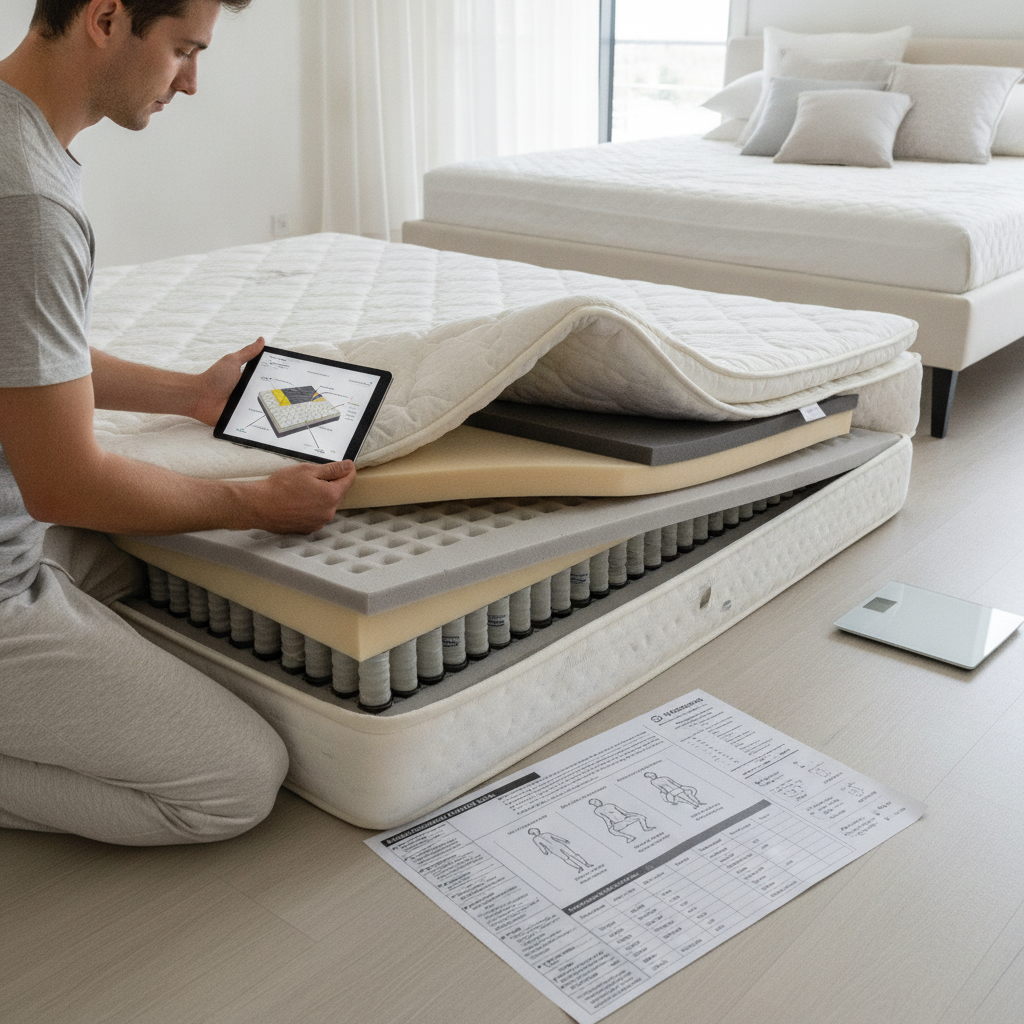
Mattress firmness ratings are among the most misunderstood numbers in consumer shopping — and relying on them without context can mean spending hundreds of dollars on a bed that works against your body rather than with it. A "medium-firm" label from one brand rarely translates the same way at another, and the gap between marketing language and actual support can affect everything from spinal alignment to morning stiffness. Understanding how to read the underlying specifications cuts through that confusion before a purchase is made.
What Do Firmness Numbers Actually Measure?
Most mattress brands use a scale from one to ten, where one represents the softest feel and ten the firmest. But that scale is self-assigned, meaning a Saatva "Luxury Firm" at a 6 might feel meaningfully different from a Purple "4" rated at a similar number. What the scale measures is surface feel — the initial sensation of lying down — not the structural support happening beneath. Shoppers who understand this distinction start looking past the firmness number toward the specifications that actually determine support: foam density, coil gauge, and layer arrangement.
How Does Foam Density Affect Real Support?
Foam density, measured in pounds per cubic foot, is one of the most reliable indicators of long-term support and durability. Low-density foams — typically under 3 lbs per cubic foot — compress quickly under body weight and lose their shape faster over time. High-density foams, in the 4 to 5 lb range, resist compression more evenly and maintain support across different body zones. A mattress labeled as medium-firm but built with low-density foam layers may feel appropriate at first but gradually conform too deeply, particularly for heavier sleepers. This is why density specs matter more than the firmness number printed on the tag.
Which Sleep Positions Require Different Specification Profiles?
Side sleepers generally benefit from softer surface layers combined with firmer support cores. Their pressure points — hips and shoulders — need enough give to prevent pinching, but the spine still requires underlying resistance to stay aligned. Back sleepers typically need a flatter, more uniform surface, which points toward medium-density foam layers or pocketed coils with consistent gauge throughout. Stomach sleepers, who face the highest risk of lumbar strain, are best served by firmer configurations that prevent the midsection from sinking. Brands like Helix and Nectar publish detailed position-specific recommendations alongside their layer specifications, making cross-comparison more practical.
How Does Body Weight Change the Firmness Equation?
A firmness rating that suits a 140-pound sleeper will behave entirely differently under someone weighing 220 pounds. Heavier individuals compress foam layers more deeply, which means a medium-firm mattress can function like a soft one at higher body weights. Coil gauge becomes particularly relevant here — lower gauge numbers indicate thicker, stiffer wire, which provides more resistance. A mattress with 14-gauge coils will support heavier sleepers more consistently than one built with 16-gauge coils at the same firmness rating. Lighter sleepers, conversely, may find that firmer mattresses never fully respond to their body shape, leaving pressure points unsupported.
What Should You Look for in a Full Specification Sheet?
When you pull up a mattress spec sheet, the most useful figures to examine are foam density by layer, coil gauge and count, comfort layer thickness, and the ILD rating. ILD — Indentation Load Deflection — measures how many pounds of force are needed to compress foam by 25 percent. A lower ILD means softer foam; higher means firmer. Brands like WinkBeds and Avocado publish ILD values alongside their layer diagrams, which allows direct comparison. Look at the comfort layer ILD separately from the transition and support layers — each plays a different role, and a low ILD on the surface doesn't necessarily mean inadequate overall support.
How Can You Apply This Before Making a Purchase?
Before committing to any mattress, pull the full specification sheet rather than relying on the product description. Search the brand's website for terms like "construction details," "materials," or "layer breakdown." If those specs aren't published, that's itself a signal worth noting. For side sleepers under 160 pounds, look for comfort layers with ILD values between 14 and 19 and foam densities above 3.5 lbs. For back or stomach sleepers over 200 pounds, prioritize support cores with coil gauges at 14 or lower and foam densities at 4 lbs or higher. Many brands — including Casper and Brooklyn Bedding — offer free trial periods, so if the specs seem close but not certain, an in-home test is a legitimate part of the evaluation process.
Matresses are rarely a one-size-fits-all purchase, and the firmness number on a product page is only the beginning of the story. Reading the actual construction specifications — foam density, coil gauge, ILD ratings, and layer thickness — gives a far clearer picture of how a mattress will perform for a specific body type and sleep position. Those details are usually available for shoppers who know to look for them, and they consistently lead to better decisions than surface-level ratings alone.